
 EN
EN
 English
 Español
 Français
 Português
 عربى
عربى
Auto Wire Pay-Off Machine vs Manual: Complete Comparison
Content
- 1 Understanding Wire Pay-Off Machine Functions
- 2 Manual and Passive Pay-Off Systems Explained
- 3 Automatic Wire Pay-Off Machines Explained
- 4 Performance Comparison Across Key Metrics
- 5 Application-Specific Selection Guidelines
- 6 Return on Investment Analysis
- 7 Advanced Features in Modern Automatic Systems
- 8 Making Your Selection Decision
Wire pay-off machines serve as critical components in wire processing operations, controlling how wire feeds from storage spools into downstream equipment like drawing machines, stranding lines, or cable manufacturing systems. The choice between automatic wire pay-off machines and manual or passive systems significantly impacts production efficiency, wire quality, operational costs, and worker safety. As manufacturing demands increase for higher speeds, better tension control, and reduced downtime, understanding the fundamental differences between these systems becomes essential for optimizing wire processing operations. This comprehensive guide examines automatic versus manual wire pay-off solutions, providing detailed analysis to help you select the optimal system for your specific production requirements.
Understanding Wire Pay-Off Machine Functions
Wire pay-off machines, also called unwinders or dereelers, control the release of wire from storage spools or coils to downstream processing equipment. The primary function involves maintaining consistent wire tension while accommodating varying consumption rates from the receiving equipment. Proper tension control prevents wire from loosening and tangling or pulling too tightly and breaking, both of which halt production and create quality issues. The pay-off system must also accommodate different spool sizes, wire diameters, and material types while operating reliably across extended production runs.
Beyond basic unwinding, modern pay-off machines provide crucial functions including tension monitoring and adjustment, spool rotation speed control synchronized with downstream equipment, automatic spool changeover to minimize downtime, and safety features protecting operators from rotating components and wire breaks. The sophistication of these functions varies dramatically between manual passive systems and fully automatic active pay-off machines, directly affecting production capability, product quality, and operational efficiency.
Manual and Passive Pay-Off Systems Explained
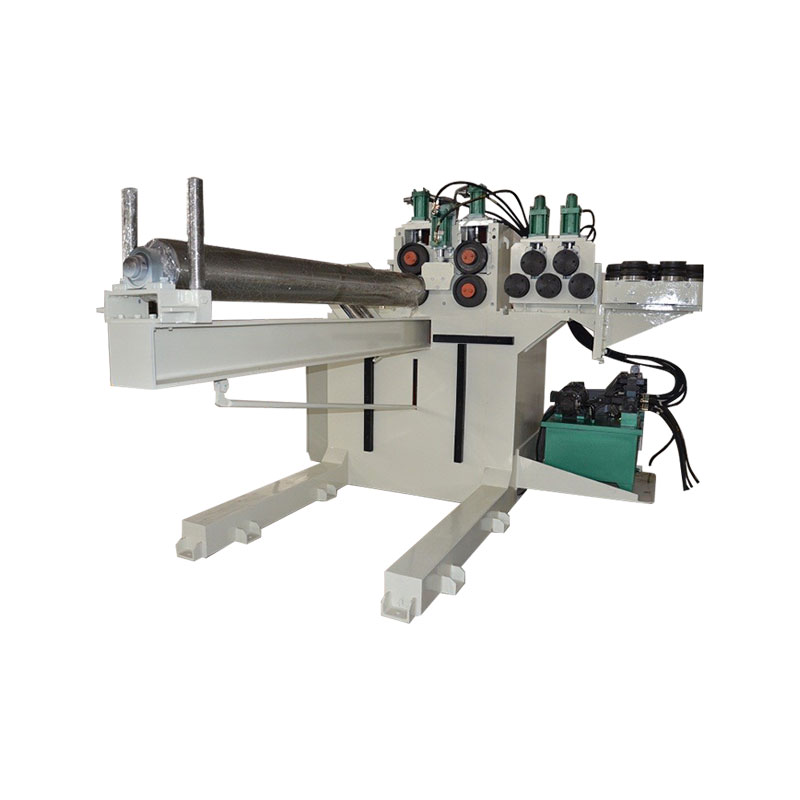
Manual or passive pay-off systems represent the simplest approach to wire unwinding, consisting of a spindle or shaft that holds the wire spool with minimal additional control mechanisms. The wire spool rotates freely as downstream equipment pulls wire, with rotation resistance from bearing friction and optional mechanical braking providing basic tension control. These systems rely on the inertia of the rotating spool and gravity to maintain wire supply, requiring minimal electrical power or control systems. Simple mechanical brakes, magnetic particle brakes, or friction clutches provide adjustable resistance to prevent spool overrun when downstream equipment slows or stops.
Operators manually load spools onto the spindle, thread wire through guides and tensioners, and adjust brake settings based on wire characteristics and production speed. When spools deplete, production stops while operators remove empty spools and install fresh ones, creating downtime that impacts overall equipment effectiveness. These systems work adequately for low-speed operations, intermittent production runs, or applications with forgiving tension requirements where slight variations don't compromise product quality.
Advantages of Manual Pay-Off Systems
- Lowest initial capital investment, typically 70-90% less than automatic systems
- Simple mechanical design with minimal maintenance requirements
- No electrical controls or programming needed for operation
- Suitable for multiple wire sizes with simple mechanical adjustments
- Easy troubleshooting and repair using basic mechanical skills
- Minimal floor space requirements for compact operations
- Low energy consumption with passive operation
Limitations of Manual Pay-Off Systems
- Inconsistent tension control causing quality variations and wire breaks
- Limited maximum operating speeds, typically under 200 meters per minute
- Spool inertia creates tension spikes during speed changes or stops
- Production stops required for manual spool changeover
- Higher scrap rates from tension-related defects
- Operator dependency for tension adjustments and monitoring
- Safety concerns from exposed rotating components
- Cannot accommodate fine wire or delicate materials requiring precise tension
Automatic Wire Pay-Off Machines Explained
Automatic wire pay-off machines employ sophisticated control systems that actively monitor and adjust wire tension in real-time, maintaining consistent conditions regardless of downstream speed variations or spool depletion. These systems utilize servo motors or variable frequency drives (VFDs) to control spool rotation speed, synchronized with wire consumption through feedback from tension sensors and dancer arms. The dancer arm, a pivoting roller assembly with adjustable counterweights or pneumatic cylinders, physically responds to tension changes by moving up or down, triggering the control system to accelerate or decelerate spool rotation accordingly.
Advanced automatic pay-off machines incorporate programmable logic controllers (PLCs) or dedicated motion controllers that process multiple inputs including dancer position, wire speed, spool diameter (calculated from rotation speed and wire consumption), and operator setpoints. The control system continuously adjusts motor speed to maintain the dancer arm within its optimal operating range, ensuring consistent wire tension typically within ±2-5% of setpoint. Many systems include features like soft-start and soft-stop functions that gradually accelerate or decelerate to prevent tension spikes, automatic spool diameter calculation that adjusts control parameters as spools deplete, and integration capabilities with upstream and downstream equipment for coordinated operation.
Advantages of Automatic Pay-Off Machines
- Precise tension control maintaining consistency within ±2-5% of setpoint
- Supports high-speed operation exceeding 1000 meters per minute for suitable wire types
- Automatic compensation for speed changes and spool depletion
- Reduced scrap rates through consistent tension eliminating quality defects
- Optional automatic spool changeover systems minimizing production interruptions
- Handles delicate materials including fine wire and specialty alloys safely
- Integration with production management systems for data collection and analysis
- Enhanced safety features with automatic shutdown on fault conditions
- Reduced operator intervention allowing staffing optimization
Limitations of Automatic Pay-Off Machines
- Significantly higher initial investment, 5-15 times manual system costs
- Complex electrical and control systems requiring specialized maintenance expertise
- Higher energy consumption from motors and control systems
- Programming and setup requirements for different wire types and speeds
- Larger floor space requirements for dancer assemblies and control cabinets
- Potential single-point failure risks if control systems malfunction
- Training requirements for operators and maintenance personnel
Performance Comparison Across Key Metrics
| Performance Factor | Manual/Passive System | Automatic System |
| Tension Accuracy | ±10-20% | ±2-5% |
| Maximum Speed | 50-200 m/min | 500-1500 m/min |
| Spool Changeover Time | 5-15 minutes | 0-3 minutes (with auto-change) |
| Initial Cost | $2,000-$8,000 | $15,000-$80,000 |
| Scrap Rate | 3-8% | 0.5-2% |
| Operator Attention Required | Continuous monitoring | Minimal supervision |
| Maintenance Complexity | Low | Moderate to High |
| Fine Wire Capability | Limited (>0.5mm) | Excellent (0.01mm+) |
Application-Specific Selection Guidelines
When Manual Systems Remain Viable
Manual or passive pay-off systems continue serving effectively in specific applications where their limitations don't compromise production objectives. Small-scale operations producing short runs of various wire types benefit from manual systems' simplicity and quick changeover between products without reprogramming. Job shops and prototype manufacturing environments appreciate the flexibility to accommodate diverse wire sizes and materials with simple mechanical adjustments rather than software configuration.
Applications producing heavy-gauge wire above 3mm diameter where tension variations have minimal impact on product quality can utilize manual systems without quality compromises. Low-speed operations running under 100 meters per minute, such as certain spring winding or cable assembly processes, operate successfully with passive pay-off. Budget-constrained startups or operations with limited capital can begin production using manual systems, planning upgrades to automatic equipment as production volume and revenue grow.
When Automatic Systems Become Essential
Automatic wire pay-off machines become necessary for high-speed production exceeding 300 meters per minute where manual systems cannot maintain consistent tension control. Fine wire operations producing wire below 0.5mm diameter require the precise tension control that only automatic systems deliver, as tension variations cause immediate wire breaks or quality defects. Applications where wire tension directly impacts product quality, such as precision spring manufacturing, medical wire, or aerospace components, demand automatic systems' consistency to meet specifications.
High-volume continuous production runs benefit from automatic pay-off machines' reduced downtime through optional automatic spool changeover systems that maintain production while operators reload empty spindles. Operations processing expensive specialty alloys or precious metals justify automatic systems through reduced scrap rates that quickly offset higher equipment costs. When labor costs represent significant operational expenses, automatic pay-off machines reduce operator requirements, allowing personnel reallocation to higher-value tasks while machines maintain consistent operation.
Return on Investment Analysis
Evaluating return on investment for automatic versus manual pay-off systems requires comprehensive analysis of both direct and indirect cost factors over expected equipment life. The initial price differential represents only the starting point, as operational savings from automatic systems can justify higher investment through multiple mechanisms. Reduced scrap rates deliver immediate material savings—a reduction from 5% to 1% scrap in operations consuming $500,000 annual wire translates to $20,000 yearly savings in material costs alone.
Increased production throughput from higher operating speeds and reduced changeover downtime directly impacts revenue generation capacity. An automatic system enabling 50% speed increase or reducing changeover downtime by 30 minutes per shift can add substantial production capacity equivalent to adding partial shifts or additional equipment. Labor savings from reduced operator attention requirements allow workforce optimization—one operator monitoring multiple automatic pay-off systems versus dedicated attention to manual equipment creates measurable cost reduction.
Quality improvements reduce customer complaints, returns, and warranty costs while potentially enabling access to higher-value markets demanding tighter specifications. Energy costs may increase with automatic systems' motor drives, but this typically represents minor expense compared to material and labor savings. Maintenance costs run higher for automatic systems requiring periodic servo motor servicing, sensor calibration, and control system updates, but these expenses usually remain modest relative to operational benefits. Most manufacturers find automatic pay-off systems achieve payback within 12-36 months in high-volume production environments, with shorter payback periods for fine wire or expensive material applications.
Advanced Features in Modern Automatic Systems
Contemporary automatic wire pay-off machines incorporate sophisticated features extending beyond basic tension control to optimize production efficiency and quality. Automatic spool identification systems using RFID or barcode scanning read wire specifications from spool labels, automatically loading appropriate control parameters and eliminating setup errors from manual data entry. Predictive maintenance systems monitor motor current, bearing vibration, and component wear patterns, alerting operators to service requirements before failures occur and scheduling maintenance during planned downtime.
Integration with enterprise manufacturing systems enables real-time production monitoring, quality tracking, and efficiency analysis. Modern systems communicate via industrial protocols like Profinet, EtherCAT, or OPC-UA, sharing data with production management software that tracks material consumption, calculates overall equipment effectiveness (OEE), and identifies optimization opportunities. Remote diagnostics capabilities allow equipment suppliers to access control systems via secure internet connections, providing troubleshooting support and software updates without requiring on-site service visits that cause extended downtime.
Making Your Selection Decision
Choosing between automatic and manual wire pay-off systems demands systematic evaluation of your specific operational requirements, production characteristics, and business objectives. Begin by assessing your wire size range and material types, as fine wire below 0.5mm or delicate materials essentially require automatic systems regardless of other factors. Analyze your production speeds and determine whether manual systems' speed limitations constrain your throughput goals or create competitive disadvantages.
Evaluate quality requirements and customer specifications to determine if tension control precision affects your ability to meet tolerances or maintain consistent product characteristics. Calculate current scrap rates and material costs to quantify potential savings from improved tension control. Review your production schedule to understand changeover frequency and quantify downtime losses that automatic systems could minimize. Consider your workforce availability and labor costs, as automatic systems provide greatest benefit where labor represents significant operational expense.
Assess your maintenance capabilities and determine whether your team possesses skills to maintain and troubleshoot automatic systems or if manual equipment better matches available expertise. Analyze your capital budget and financing options, considering whether equipment leasing or phased implementation makes automatic systems accessible despite higher initial costs. Project your production growth trajectory to avoid selecting systems that quickly become inadequate as volume increases. By methodically evaluating these factors and consulting with equipment suppliers who can demonstrate how specific machines address your requirements, you can confidently select the pay-off system that optimizes your wire processing operation's performance, quality, and profitability both today and into the future.